As a Quest Volunteer for Haiti, I will be spending a year not only doing service, but learning more about the people and culture of Haiti, the beauty of the country, the challenges they have faced, are currently facing and potential solutions to these difficulties. I am also hoping that I will build on the skill-set I have already developed, expand my knowledge in general, and become a better and more aware global citizen. Throughout the year, I will be posting about the work I am doing, observations I have made, and in general reflecting on what I have learned about the country and myself. Happy reading!!

Sunday, December 7, 2014

Say cheese...

Here are some pictures of what's happened over the past few weeks!!


Love this picture!  This little girl was helping me clean up after one of the art lessons.

One of the only pictures I have where everyone is smiling and looking at the camera!

Our final color wheels.  Students were sent out into the school yard to find objects that matched the colors on their wheels.  It was so fun to watch them all running around looking for things and then sharing their findings so every student had a piece in each section.


We had several cases of these donated by Food for the Poor a while ago.  We found the last case in our basement a week or so after we got here.  I mixed the slightly stale puffs with corn flakes every morning for two months and we finally finished the last box...


New wildlife spotted - Guinea fowl!


Since I have been here, I have been extremely lucky, health wise.  But, my luck finally ran out.  I am currently treating myself for ringworm, a kind of fungus, that I most likely contracted from contact with a kid who had it.

This is another fungus that was scratched until it became infected.  I saw it only a few days after I realized I had ringworm.  It immediately made me thankful that mine was only on my elbow and was just about the size of a nickel.  After giving the little boy a round of antibiotics as well as fungal and antibiotic cream, it cleared up and his neck is looking much, much better.


We had a few pretty bad rainstorms several days in a row.  School was actually canceled because kids were unable to to get across this new lake.


Around the same time we were having rain storms, my parents were having snow storms that caused massive power outages all over the state of Maine.  It was interesting to see the difference between what closes school to be canceled here and back home.


Suzie and I just hanging out.  She just had four kittens!


First grade on their way to computer class.


Diligently working on pictures using different kinds of lines.


Once on this island...

Halloween was the first major holiday that we had here, and I was very interested to see how we/the country as a whole were going to celebrate it.  Halloween, as we know it in the States, is not really a thing here.  Kids don't get dressed up and go from house to house collecting candy.  Instead, it is more of a religious holiday.

November 1st is All Saints' Day and then November 2nd is All Souls' Day.  All Saint's Day celebrates all those people who have "attained the beatific vision" or actually seen God (Wikipedia), while All Souls' Day remembers those who have died.  There are many ways in which these days are celebrated around the world.  In many countries people visit the graves of loved ones, light candles, leave offerings of food and celebrate their life.

Just like other countries around the world, Haiti has its own way of celebrating these days.  For example, many people who follow Christianity attended a service and pray for the deceased.  Yet, this is only one of the ways that Haitians observe these holy feast days.  While 80% of population here consider themselves to be Roman Catholic, at least half of the population practices a religion known as Voodoo (CIA World Factbook).  Voodoo has a long history in Haiti, with its origins stemming from the thousands of African slaves who were brought to the island during the 17th and 18th centuries to work on sugar plantations.  But it also incorporates aspects of Catholicism.  In general, voodoo in Haiti refers to "all African-derived religious practices..." (Olmos, pg. 102).  (I know the citations make this a little more formal, but thanks to my four years at college, I was taught to always cite your sources...no matter what!!)

There is one, rather distant, god at the top of the voodoo religion.  This god is not openly concerned with people on earth, but transmits his desires and power through the many "lwa/loa" or spirits that link humans with the divine (Olmos, pg. 105, 109).  The lwa give "help, protection, and counsel" while believers give "ritual service" which take both individual and communal forms (Olmos, pg. 102).  These include feeding the spirits, the offering of sacrifices, and group ceremonies.  Voodoo priests communicate with these spirits and gods while being possessed and then pass the message along to other believers.  The spirits are derived from African gods, Creole gods and Catholic saints.

The spirits can be divided into two families, the Rada or "dous" (sweet) gods and the Petwo or "anme" (bitter) gods (Olmos, pg. 110).  There are many spirits within the Rada family including Papa Legba, Azaka, Agwe, and Ezili Freda.  Legba is the god who "'removes the barriers'" between the earth and the spirit world.  His permission must be asked before ceremonies proceed or other gods can be called (Olmos, pg. 110).  Agwe is god of the water - "captain and protector of ships at sea, of all marine or aquatic life , and of fishermen" (Olmos, pg. 111).  Azaka is the god of agriculture and people who work the land.  Ezili Freda is the "goddess of love and luxury."  Fun Fact - For those of you who have seen the musical Once on this Island, the characters from the play are based on these spirits and the strong belief that the gods will provide, punish and protect those on earth can be seen in Haitian culture today.

Although there are several gods within the Petwo family, I am going to focus on one, because it brings us back to the main topic of this post - Halloween/Day of the Dead.  Bawon Samdi (Baron Saturday) is said to be the leader of the Gede's, a family of spirits that are "confined to the world of the dead" (Olmos, pg. 113).  These spirits are mischievous and during ceremonies bring "merriment and...coarse, raunchy jokes" (Olmos, pg. 113).  Bawon Samdi is thought to be obscene and disruptive and a strong lover of tobacco and rum.  He accepts individuals into the realm of the dead, but can also heal those who are near death.  He is often depicted wearing a black suit, a top hat and sunglasses.

It is this god who is celebrated during All Saints and All Souls day.  I personally did not witness any of the festivities, but according to the several articles that I have read, it looks like there are large celebrations in Port-au-Prince.  For example, large crowds gather at a cross dedicated to Bawon Samdi in the National Cemetery.  Some pray, some become possessed by members of the Gede family and many dance and sing.  In addition to this, people light candles and visit the graves of the deceased.

This is only a rough outline of voodoo here in Haiti.  There is much more to the religion than what I have given you.  Voodoo is an extremely important part of Haitian life and culture.  In a short National Geographic video I watched, it said that while many people in the country consider themselves Christian or Catholic, everyday life still moves in the realm of the spirits.  I have not had that much firsthand experience with voodoo here, but I have heard voodoo ceremonies from afar, which included constant and intense drumming.  Beth and I heard some kind of healing ceremony from a voodoo temple near the school.  We did not see anything, but we heard chanting/singing and what sounded like spitting, as if someone was trying to rid themselves of something.  I have heard that some sick people, whether it be a physical ailment or a mental one, will go to voodoo priests for healing instead of, or in addition to, going to a doctor.  Given these, as well as other stories that I have heard, it was nice to learn more about voodoo and shed some light on something that, up until now, was an aspect of Haitian culture that I knew very little about.


Our Halloween was much more "traditional" in the American sense.  We decided that everyone needed to dress up and Beth and I made a throughly "spooky" dinner.  We decorated our dinning room, watched Hocus Pocus and even got candy corn!  It was a fun evening and it was awesome to see how creative everyone got with their costumes.

Happy (late) Halloween!!

Since we couldn't carve any pumpkins...

The rest of our ghoulish grub - pumpkin shaped carrots, bone breadsticks, pumpkin cupcakes, red gatorade with hand ice cubes and stuffed peppers with brains (ground beef and red sauce) spilling out.

Frankie, the hippie, Pippy Longstocking (aka Beth), and the majestic peacock!


The whole clan lookin' sharp!  Sr. Pat, Sr. Jackie, Frankie, and myself are in the back.  Beth and Eliza are in the front.

The elusive peacock was spotted in her natural habitat attempting to look as bird-like as possible.

These seemed a fitting treat for the house – Jesus Promise Seeds that were pastel-colored candy corn.  It was pretty nice to have this Halloween staple.


Sources:
  • Olmos, Margarite Fernandez, and Lizabeth Paravisini-Gebert.  Creole Religions of the Caribbean: An Introduction from Vodou and Santeria to Obeah and Espiritismo.  New York: New York University Press, 2003.  (I found it on Google Books.)
  • http://www.wehaitians.com/day%20of%20the%20dead.html
  • http://en.wikipedia.org/wiki/Baron_Samedi
  • http://video.nationalgeographic.com/video/haiti_haitianvoodoo
  • https://www.cia.gov/library/publications/the-world-factbook/geos/ha.html

Sunday, November 16, 2014

Down By the Schoolyard

One of the projects that Beth took on in the school was organizing the principal's office.  She helped him go through the cupboards and sort through his papers as well as the papers he inherited from the old principal.  While she was doing all this organizing, she decided that since the rest of the office was going to look fresh and new, it might be nice to repaint the office.  So, that's what we did.  The principal wanted to change the walls from a dark green-ish teal color to cream.

The process itself was quite an adventure.  For one thing, we did most of the work while school was in session and we always had kids trying to come in the office, crowding around us when we were cleaning the brushes, or finding ways to get paint all over their arms despite our washed brushes and paint trays.  It took three trips to the paint store before we finally had enough paint for all the necessary coats.  We had gotten two gallons of cream paint and when we opened them, we discovered that they were actually two different shades of yellow, so instead of the nice cream the principal wanted, he now has a buttery-yellow office.  The rollers that we had weren't very good either and kept breaking.  We ended up breaking all three of the rollers we had over the course of our work.  We used our hands as rollers and I even put my very basic engineering skills to the test to fix one of the rollers so we had at least one with a handle.

It was a fun week, and the office looks much brighter than before.  Before, it was dark and and it was pretty dirty.  Now, after scrubbing the walls, sweeping all the rat poop out and 4 new coats of paint, it is light, clean and much more welcoming.

It has been very interesting working at the school.  I have been able to learn a lot about the education system here in Haiti.  Here are some of the things that I have learned.

Just like in the US, there are both public, parochial and private schools here in Haiti.  It seems however, that the majority of schools are parochial or private.  There are dozens of schools here in Gros Morne and only a handful of them are public.  In the country as a whole, over 80% of primary schools are privately managed by churches, NGOs, and other organizations (data from USAID).  Public schools are not completely free, because students are required to buy books, uniforms, and pay for exams or other fees.  Students in parochial schools must pay some of these costs as well as additional tuition fees.  School here costs between $50 and $300 depending on the school and whether or not it is an elementary or high school.  It should be noted that the average GDP per capita (average income) is only $820 a year.  In fact, according to USAID, school expenses can take up around 40% of a family's income.

Sr. Pat has been dealing with two current issues within the education system.  Over the past few years, the government started subsidizing the 1st grade in all schools, not just ones run by the government.  The next year it expanded to the 1st and 2nd grades, and the following year it included the 3rd grade.  Schools were under the impression that the 4th grade would be added this year, so schools told parents that tuition costs would be less for children in those grades.  However, in late August, schools found out that only the 2nd, 3rd and 4th grades were going to be subsidized, which caused problems for parents who were thinking they would not have to come up with money for tuition but now did.  Because these grades are subsidized by the government, it means that the government should be supplying books for all students in the 2nd, 3rd and 4th grade.  It's November, and many schools have not yet received the funds to supply their students with the necessary books, so kids are without the necessary materials.  In fact, I believe there are still funds from last year that have not been provided to schools yet.

The second problem has to do with school lunches.  Schools are required to feed their students and many schools received aid from the World Food Program to supply food for their students.  This year, however, private schools found out, (again, in late August), that they would not be able to receive assistance from the WFP.  It turns out that the government told the WFP that they could not support private and parochial schools, only government schools.  Because the WFP is an international organization, it must respect the requests of the national government - thus, many schools are struggling to provide their students with food every day.  Sr. Pat and a group of school principals and local leaders are working to change this government mandate.

I have also noticed that there are many children who do not go to school.  When walking around Gros Morne during the day, (while school is in session), it is not uncommon to see some kids collecting water, helping their mother sell things on the side of the street, or just walking around.  Although some of these kids attend the afternoon session some schools have, (because there isn't enough space for all the students to go at one time), some are just not enrolled in school.  The common reason for this is that they cannot afford the costs associated with education.  I did a little research, and it seems that around 77% of primary school-aged children actually attend primary school and that only 85% of these children complete their entire primary school education (statistics taken from UNICEF).

Ok, that's enough statistics for now.  I'll keep other information for another post.  Enjoy the pictures!


Before - scrubbing the walls.


Beth and I took a "selfie" every day, to track our progression.  Here's one from the first day.

Finally done with the primer after three coats!


Discovering we had two different shades of...yellow!  Not the cream we thought it was going to be.


Our makeshift roller handle.


Done!


The schoolyard!


Preschoolers during their "gym" period.


The usual schoolyard activities - how many kids can we pile on to Beth or Katie!


The "Dirt" on Haiti

Before I begin, I would just like to take some time to apologize for the lengthy delay between posts.  I could blame everything on Beth because it took her forever to send me some photos that I needed, but I will take responsibility and admit that things have been pretty busy and I haven't found time to sit down and write.

It's crazy that we passed our two month mark on the 27th of October.  At times, I feel like we just got here, yet other times I feel as though I have been here for much, much longer.  I'm amazed at how far each of us have come in terms of communicating with others, working independently on our projects, killing spiders, and dealing with seemingly constant requests for money, food, or other assistance from strangers on the street.  I have already done things I had never imagined myself doing: learning how to milk a goat, figuring out a loan repayment plan for a basket-maker who owes over $700, giving people medicine, etc.  I'm interested to see what the next 10 months have in store.

The last time I posted, we had gone to the beach and had collected rocks to repair the gardens at Lèkol Jezi-Mari in Fon Ibo.  I would like to continue our garden story.  The original gardens had been put up by a former Quest volunteer around 5 years ago, and beans, spinach and other various vegetables had been planted in them.  Since then, the plants have not been well taken care of and the cement brick and rock walls had started to collapse.  Because the gardens could be used to grow some food that students can eat for lunch as well as act as a wonderful learning and teaching tool, Sr. Pat and Beth really wanted them to be repaired.  This task was given to the 5th grade.  One of the first steps that we took in this process was to attend a local conference about several methods to improve soil quality.  I spent two days at the conference, and on the second day, we were able to have the 5th grade teacher and two students come so they could bring the information back to the school and the rest of their class.

The main topics of the conference were how to prepare a compost pile that will produce good and healthy compost that can be added to soil, how to make compost using worms, and an agricultural method known as double digging.  I will go into a little detail about each of these, but (hopefully) not enough to put you all to sleep!

Much of Haiti's soil has been depleted.  At the end of the conference, we were able to listen to a professor from the University of Florida, (who happened to be in the area), give a lecture.  He was trying to continue research he had been doing in Florida about improving soil conditions in Haiti.  He said that Haiti has lost 90% of the soil it had before it was colonized.  This loss has been due to the nature of the crops that were grown, (coffee, tobacco, etc.), during colonization, the intense deforestation that has left less than 3% of the land forested, and severe erosion that is augmented by the mountainous terrain.

While many farmers do not do anything to replace nutrients back into the soil, some make and add compost.  At this conference, we learned about why compost was important for reintroducing microorganisms back into the soil, and the different components you need to make good compost - earth, green and dry material and water.  We also discussed using urine as well as manure and the potential benefits and health risks of using these materials.  We were able to see the process of making a compost pile that could be reproduced almost anywhere.  The professor also talked a little bit about how one of the main nutrients that is missing in the soil is carbon.  He looked at ways to replenish the carbon supply in the soil, specifically using bio-char and charcoal.  He talked about a method that was used before the country was colonized when natives were making large mounds of earth and adding charcoal to the mounds.  He has replicated this technique in Florida and within 6 weeks, the soil was black and rich in carbon.  He is trying to see what will happen if they do this in Haiti.

Double digging is a method used by some farmers to help aerate the earth and to help it maintain moisture.  It is apparently very good for the soil and if this process is used, you can go several years without having to repeat the process or re-till the earth.  Double digging includes removing a small trench of earth, setting aside the top soil, filling the hole about 3/4 of the way with the dirt you just removed and then taking the top soil from the next trench and filling in the first trench the rest of the way.  These two steps are repeated for as much as you need dug.  You can add compost to the soil to enrich it even more and once you are finished, you can use rice husks, wood chips and straw/corn stalks to cover it to help retain even more moisture.

We also learned a little bit about how you can use worms to make compost.  The correct term for this is vermicompost.  Although Haiti has its own species of worms, a certain species of African worms as well as one from California are much better for this process–although they are not readily available in Haiti.  The way vermicompost works is that you have a bunch of worms in either a wooden or plastic bin.  You feed them nutrient-rich food scraps (mostly fruits and vegetables).  The worms digest the scraps and essentially poop out nutrient-rich compost that can be added to the soil.  This technique is not widely used in Haiti, but some agriculturalists are hoping to introduce it in some areas.

I went to the conference to learn more about the Haitian environment and agricultural techniques but we wanted a teacher and the students to go to see if any of the information could be brought back to the class and used in the gardens.  Fortunately, we were able to do just that.

A few days ago, after all the mud from the several days of rain had finally dried a little bit, we were able to fix the garden walls with the rocks Beth, the 5th graders and I had collected a few weeks ago.  Beth, Claude, (the school's all around awesome handyman), another of the school's workers and I spent a few hours ripping out all the old plants, removing the leaf detritus and turning the soil.  Last Saturday, Beth and I went to the school to help the 5th grade put in their compost pile–exactly how we had seen at the conference.  It was clear that they had talked about compost in class because they knew the all the steps that went into constructing a pile, what kind of leaves were best, how big everything needed to be, etc.  The kids did 95% of the work and were merely guided by their teacher and Claude.  It was so cool to see all the kids working together and having fun while they were doing the work and actually using the information from the conference.  I can't wait to continue watching the kids build their gardens and I hope that we will be able to start planting in them soonish.


A double digging demonstration at the conference.


Building the compost pile during the conference.


An example of a box for worm compost.


All the participants of the conference.


Learning about adding charcoal to your soil.


The  5th grade!


Our gardens are called "keyhole" gardens because of their shape.  This kind of garden does well in areas that are hot and dry because they retain more moisture and nutrients because  there is what is called an "active" compost pile in the middle of each garden.  There are many ways to make a keyhole garden, including layering different materials within the garden.  For example, one website I looked at recommended layering wood, cardboard, compost, newspaper, manure, worms, ash, straw and then topsoil to really increase soil health.  
(http://www.inspirationgreen.com/keyhole-gardens.html) 

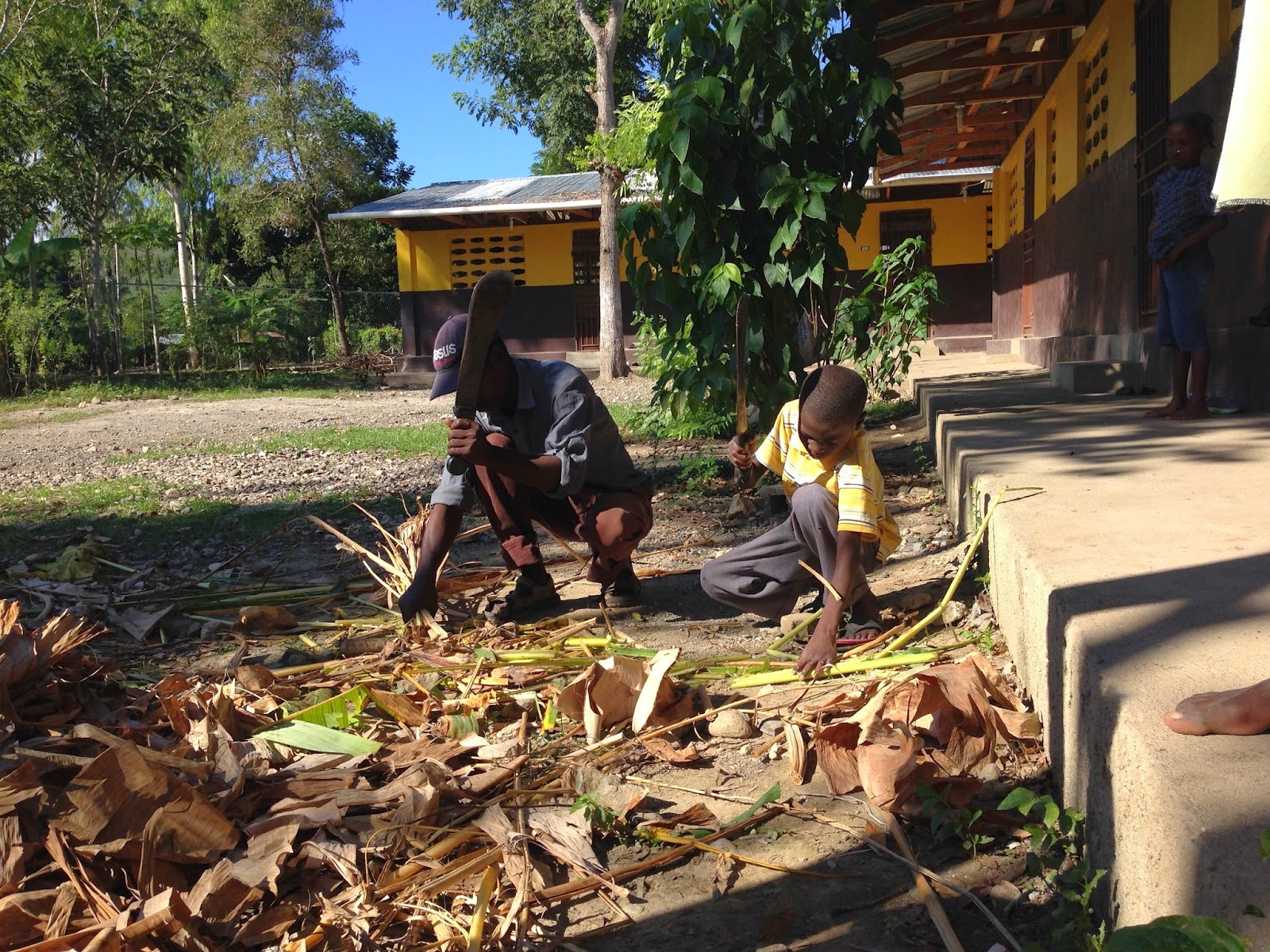
A man cutting some branches off the trees to increase the amount of sunlight that reaches the gardens.


Preparing the pile.


Chopping up the stalks from palm leaves to add to the pile.


Our growing pile.


The final product!!


Monday, October 20, 2014

A Few More Kodak Moments...

October 18th was National Chocolate Cupcake Day.  Obviously we had to celebrate that, so I made a batch of cupcakes with homemade chocolate-peanut butter frosting.  I can honestly say that they were some of the best (looking and tasting) cupcakes I've ever made!


Beth, Frankie and I looking classy at the beach!


We spent one Saturday morning collecting the materials from the literacy program that was happening in the Village, that will no longer be taking place.  I got to stand in the back of the pickup truck and help Beth make sure the chalkboard didn't fall out.  It was a little scary going over all the bumps.


We spent one Sunday afternoon at Tiden's bar/restaurant where there is access to parts of the river that are deep enough to swim.  It was the first time I had been swimming since the beginning of August and I was very happy to be in the water again.  I made friends with some of the kids that were also playing in the river, and we had fun jumping off the rocks together.


I clearly had a horrible time!!!


I've spent a few afternoons at the school helping to entertain the preschoolers who end an hour before the rest of the school finishes.  Many of them wait around for older siblings to finish before they walk home together.  Beth and I have had a great time hanging out with them!  They're very cute and fun to play with!


Getting all kinds of kisses!


One of the projects at the school is to fix the raised beds that are in the school yard and to replant them so that the garden is productive again.  The 6th grade is mostly responsible for this project, so Beth and I went with some students one afternoon to collect rocks from the river to repair the walls.  Although there was still some room in the wheelbarrow, the girls insisted on carrying rocks on their heads when we made our way back to school.  Beth and I gave it a try and it was incredibly hard.  Our rocks were relatively small and we didn't have to walk too far.  But women here carry huge buckets full of stuff on their heads for very long distances (with no hands to help balance it).  I'm amazed at how strong they are and how they are able to balance so much weight and walk without spilling or dropping anything.


Playing in the river!


We have thunder and lightening pretty frequently, but we've been waiting a few weeks for a really heavy rain.  It finally came yesterday.  We had crazy wind, rain and even some hail.  One of our window cranks is broken, so I had to brave the weather and venture outside to close our window and I guess Beth decided to take a picture.  I got pretty wet in the 15 seconds I was outside!