As a Quest Volunteer for Haiti, I will be spending a year not only doing service, but learning more about the people and culture of Haiti, the beauty of the country, the challenges they have faced, are currently facing and potential solutions to these difficulties. I am also hoping that I will build on the skill-set I have already developed, expand my knowledge in general, and become a better and more aware global citizen. Throughout the year, I will be posting about the work I am doing, observations I have made, and in general reflecting on what I have learned about the country and myself. Happy reading!!

Sunday, September 14, 2014

Blan! Blan!

One of our more frequent "hang outs" is Lekol Jezi Mari in Fon Ibo.  This is the school that the sisters have the closest connection with.  They work with many people on a variety of different things, but most recently they have worked to get a computer lab for the school.  We got to see it in action the other day when we went and a bunch of kids were playing math games.  Because school only started last week and most kids will be starting this Monday, we have been going after school, (around 1:00 is when they finish), to hang out with kids to practice our Creole.  I have found talking to children to be most helpful because they don't mind repeating the same thing a hundred times until it finally clicks or talking very slowly and enunciating well to ensure optimal comprehension.  It's OK too if your grammar is not spot on for them to know what you mean.  Thanks to all of the kids that I have met thus far, I have built up speed, accuracy and confidence in my speaking and improved my listening comprehension.  We mostly stay at the school, but one day we walked to the river that is nearby.  The river was incredibly warm and there were kids bathing and playing and lots of women washing clothes.  It was beautiful to see and it felt nice to put by feet in and my roommate Beth appreciated the quick rinse my stinky sandals got.

Thus far, we have met kids from two different areas.  There are the kids that live in Fon Ibo, by the school and then others from Claudine Village (the Village).  The Village is located a little ways out of town and is a neighborhood that Food for the Poor built.  Most of the people living in the Village are families that literally had/have nothing and could not afford food or shelter.  They live in these houses at no cost and many receive free or discounted food.  The first time we went to the Village it was to see the literacy program that Laura, last year's year-long volunteer, was working with.  There were two Haitian teachers that were teaching basic reading and writing to men and women who lived in the Village.  There is the potential that some of the people in this program will be the first few members of a microfinance program, but that is still in the works.  Although the kids are much dirtier than the kids in Fon Ibo, and though I definitely come home with a distinct "Village odor," I love going to the Village.  The kids love playing with us and the parents always want to talk to us.  We talk nothing but Creole, so it's great practice.  For example, today we had to talk to a mother whose son's foot had been badly injured by a motorcycle wheel and we had to try and figure out what they had already done about it, what they needed and what they should do.  It was pretty hard, but by the end, everyone understood!

Before I post the pictures, I figured I would explain the title.  "Blan" means "white" and this is all we hear when we walk down the street.  Kids shout after us until we wave, or at least turn around.  A lot of the kids don't know/remember our names so even when they are talking to us, we're called Blan.  It's a little strange to be called something according to the color of my skin, but the same thing happened in Malawi when I was called Mzungu.

The kids love getting their photos taken and to take selfies.  We hear "fè foto" or "make/take a photo" all the time.  So, here are some of our masterpieces!


Reviewing body parts.  That is your "nen."


They love to play clapping games.  They all sing the same song, and I'm picking up more words, but I still am unsure what the song is really about.


This little guy refused to smile!


I love this selfie that one of the little girls took.


Things Will Be Great When You're Downtown

Before I start on what we have done in town and my initial thoughts and impressions, I think it will be useful to situate you all geographically and to give you some basic information about Gros Morne.  The town is in the north of Haiti, as you can see from the map below.  We are very close to the convergence of three rivers, which provide townspeople with water as well as a place to wash clothes, themselves and even their motorcycles.  Gros Morne, or "Gwo Mòn" in Creole, means "Big Mountain".  We are in somewhat of valley and there are many mountains and hills surrounding us, which you will be able to see in a future post.  "Downtown" has around 30,000 inhabitants while the entire area of Gros Morne has over 150,000 people.  


When I first found out that there were 30,000 people living here, I was incredibly surprised.  In my mind, there is no way for so many people to be crammed in such a small area.  I would not consider Gros Morne to be a large town.  It is easy to walk through and it does not take more than 10 or 15 minutes to be out of town and on the road toward another village.  As I walk around more and more, I am beginning to understand the population density - given the number of alley-ways and side streets, the proximity of the houses as well as the fact there are likely many people living in one house.  We have seen a variety of different houses.  Most are made of cement and are only one story.  Almost all the houses have some kind of wall or gate around the outside.  As you move away from the city center, the buildings get a little more haphazard in terms of construction materials, fence materials and the general confidence of structural stability decreases.  In the Fon Ibo area, we have been to several houses.  These are typically one or two room buildings made out of stone or cement.  They have small dirt yards and woven reed or cactus fences surrounding the property.

Electricity is a big problem here.  We are fortunate to have solar panels on top of our house, but almost no one has as many lights as we do.  After night falls, the only lights in town are the solar street lamps that are spread out around the town and a handful of other lightbulbs in people’s houses.  People often congregate under the street lights, socializing and cooking.  Electricity is expensive and spotty at best.  Some people buy or steal wires and tap into other people's electricity without paying for it.  This has caused the electricity company to hesitate to expand their network because people are not paying for the electricity and they are losing money.

One of the main problems that I have noticed throughout town, (as well as in poorer and rural towns in South Africa and Malawi), is trash.  Because there is no municipal trash collection, roads, rivers, back alleys, everywhere essentially, is a garbage dump.  While some trash is burned, (we burn a lot of paper products and some plastic), most is just tossed outside without any second thought.

The condition of the roads is another problem that I have observed.  Although there have been improvements over the past few years and some of the main roads have been or are in the process of being paved with cement, most of the roads remain dirt.  Some of these dirt roads however, are more rocks than dirt and are easily washed away with the rain.  It is interesting to walk around after it rains and see the huge channels that have been carved out as the water rushes through.  Erosion, not only of roads, but of mountainsides and people's yards is another problem.  A current problem some of the people in Gros Morne are facing is water rushing down the side of the mountain and flooding their homes and yards after heavy rains.  There has been some organizing of homeowners and local farmers/gardeners who are affected by this to figure out the best intervention to prevent this from happening in the future.

In towns in the US, we are used to having the streets lined with different shops and restaurants or bars that one can go in and out of.  Here in Gros Morne, while there are several small shops and a restaurant/bar or two, most of the buying and selling is done directly on the street.  Mostly woman and children will set up stalls along the streets to sell clothes, food, books, backpacks, etc.  There is a designated market area with market days where vendors crowd together to sell all kinds of goods.  We went to the market the first Friday we were here and it was incredibly interesting, but overwhelming.  You had to wind through tiny pathways between vendors who were selling everything from avocados, tomatoes, and okra to unmarked pills, piles of shoes, soaps and questionable looking meat products.  All of the produce and basic staples, (rice, corn, etc), that we eat here comes from this market, but other groceries like milk and canned foods come from occasional trips to Port-au-Prince.

It has been interesting to walk around and see more and more of the town.  It is so different than any other town I have been in and I am really looking forward to not only figuring out how to get to more than two or three places, but also seeing more beyond the main streets.  I don't have very many pictures, and the ones that I do have do not really do it justice.  If I have the chance, I will take more photos and post them at a later date, but right now, these will have to do.


This is a good overview of the town.  You can see the pale green strip which is one of the rivers.  The large blue building in the lower right corner is the local public high school.

I originally wanted this picture to be of the bird, but after I went through my photos, I realized that this was one of the only pictures I have of houses.  Although it is still not an ideal photo, you can get an idea of the construction materials, the proximity, etc.


Saturday, September 13, 2014

Afternoon Delights

Because we only have class in the mornings, we are lucky enough to have every afternoon free.  I will admit I have spent some of this time reading the next book in my collection of Sherlock Holmes mysteries, napping and lounging about, but we have spent the rest of our time getting more acquainted with the area and helping out around the house.  Our ventures have included the bank, “main street,” the market, a nearby mountain/hill, the river, the local hospital, a clinic about an hour away, cleaning the refrigerator, sorting through clothing donations for the Kay Pòv (Poor House) and most frequently Lekol Jezi Mari in Fon Ibo.

Because each of these is unique in and of themselves, I'm going to split them up according to location.  This will make the posts much shorter and easier to sort through for all you guys.

Enjoy!!


Sunday, September 7, 2014

Back to School...

As fun as it sounds, I didn't just come to Haiti to go spider hunting and hang out in our beautiful house.  I came to learn and to do something.  The way the program works is that each volunteer, in addition to some general tasks, works on some project.  These vary depending on personal preference, skills, etc. but have included setting up a program where boys could play soccer after school and working on a literacy program for adults in a poor community.  Before we figure out what our project will be, however, we're focusing on getting a firm grasp of the language.  Despite our wonderful teacher in the Bronx and the huge head start we got from the classes, we still have a long way to go before we are fully comfortable and confident in our ability to listen, speak and understand.  To achieve this, we are spending the first few weeks learning the language.  As I said before, we started more Creole classes this week with Madanm Chals.  She used to work at the school in Fon Ibo which is the school the sisters have the strongest connection with.  She taught first grade, but recently broke her leg and is unable to stand for long periods, so she had to stop being a teacher.  She comes every morning from 9 to 11 to our basement classroom to work with us.  Madanm Chals speaks practically no english, so we've had to struggle through and find ways to communicate when we don't understand.  We are continuing to use the same text we used in the Bronx as well as a Grade 1 reader that is used in Haitian schools.  It has been difficult to understand, and we have played several rounds of charades in order to fully know what is happening, but we have already come so far after one week.

We are going to continue these classes for at least one more week.  After that, we will be sent on an emersion trip for a week or two.  This means that each of us is sent somewhere and we will only be able to speak and listen in Creole.  Some volunteers are sent to a village that's about an hour's drive away.  There is a medical clinic here where volunteers can help and learn and occasionally see the birth of a baby.  There is also a school where some volunteers help out and attend some of the younger grade classes to continue learning Creole.  Going to the school would be fun, but I'm pretty sure I would spend the week passed out or throwing up if I was at the clinic, considering I don't do well with such things.  Instead, I think I am going to be sent to the house of a sister who works with families to plant gardens so they can grow their own vegetables to sell and eat.

It has been amazing to see how far we've come after just a week of classes.  I am able to understand more when people talk to me and speaking is coming much more naturally and quickly.  I still have a lot to learn and my grammar, specifically the use of articles like "the" and "an" could use some work, but I definitely have learned a ton and I am looking forward to continuing classes and learning more of the language.

Here are a few more important phrases/words:
  • M'ap swe (anpil):  I'm sweating (a lot).
  • M pa kompran:  I don't understand.
  • M pa konnen:  I don't know.
  • Ki sa ou fe?:  What are you doing?
  • Ki lè li ye?:  What time is it?
  • N ap fe photo pita:  We will take photos later.  (We say this over and over to the kids we meet - they love having their pictures taken.)
  • Blan!:  White (This is technically the color, but we constantly hear "blan, blan" when we walk down the street, in reference to our skin color.)
Below are some pictures of the work we have done in class.  They may be a little difficult to read, but at least you can see that I am doing some work!!

For the past few days we have been doing listening exercises.  Madanm Chals reads sentences and vocab words, we write them down and then we go over them after to check spelling and comprehension.  


Some of our book work.  This unit was on location words - under, on, in, next to, etc.


The beginning of each chapter starts with a brief dialogue.  We read these to each other to practice speaking and pronunciation.  I'm going to toot my own horn a little bit and say that I am now reaching the point where I can read the dialogue in Creole first and understand what is happening without having to read the English translation.

Thursday, September 4, 2014

The Not So Itsy Bitsy Spider(s)

WARNING:  If large bugs, specifically of the arachnid variety, make you squeamish, do NOT continue reading.  If you're feeling adventurous, be my guest and continue.

There are so many things that I am getting adjusted to - the food, the heat, the language, etc.  We also have to get used to the creepy crawlies that we are sharing our abode with.  Some of them are nice, like the ants and little lizards.  But others are not so nice, like the giant tarantulas.  Before I go any further, I should disclose that Frankie is deathly afraid of spiders.  We knew this going in and Beth and I told her that we would protect her.  We were also told that big spiders were not seen that often, maybe once or twice a month and really only in the basement.

Friday started as a normal day.  The sun was shinning, we walked to the school for a few hours to play with the kids and practice our Creole, I read some Sherlock Holmes, sat in the sun, ate some food...you know, the usual!  Around 7:30pm everything changed.  Beth and I heard a scream from downstairs.  We thought one of the dogs was whining as he got some of his cuts cleaned, but then we heard feet pounding up the stairs.  We realized instantly that Frankie had just seen her first spider.  It was incredibly ironic that she would find the first one.  We asked her where she had seen it and she said that it was in the chapel.  We headed down the back staircase with headlamps and flashlights and Brittany who was a year-long volunteer several years ago and ended up staying for two more years and comes back frequently.  But we were held up on the second floor by another big spider hanging out on the wall of the stairs.  I'm pretty sure we all screamed.  Brittany told us to find a broom and then ran down the other stairs and came back with bug killer.  I had found a broom.  She sprayed the spider and then hit it a bunch of times with the broom.  During the commotion we learned that this was a Wolf Spider and noticed that it had an egg sac attached to its abdomen.  We could also see tons of tiny spiders crawling on the wall.  Brittany was successful and we pitched the body off the balcony.  First spider down, one to go.

This isn't a high quality picture and it doesn't really do the spider justice.  It was pretty big, maybe around 4 inches.  We could see its eyes glowing from our flashlights and it moved super quick along the wall.  The white "fur" on its back is the sac.


We descended the next flight of stairs rather gingerly, eyes peeled for more spiders, and made our way to the chapel.  It was right there, just hanging out, probably perusing the titles on the shelf looking for its next good read.  Brittany sprayed the tarantula and it ran back into the books.  We couldn't see it, so I tried taking the books off the shelf with the end of the broom while Brittany poked around.  This technique wasn't going anywhere, so Sr. Jackie, brave soul that she is, just moved the books from the shelf with her bare hands!  But we still couldn't find it.  Finally, we discovered that it was chillin' on the bottom of the shelf above, upside down, and victory was ours.

This was was a little less than 5 inches in diameter and was super hairy.

These first two spiders were alright.  I had known Haiti had big bugs and resigned myself to the fact that we would occasionally have to come face to face with them.  I had not been expecting to see one only a few days after we arrived, or to see two in one night.  I also wasn't planning on seeing two more within the next few days either.

Our third encounter with a fuzzy friend(?) was outside.  The house was smelling a little funky a few days ago.  Brittany said that it was probably a dead rat, so one evening she went outside to look for it.  I heard her and Beth shouting up to me to come down and I instantly knew what was happening.  I got my light and ran outside.  Our battle this time was pretty exciting.  He put up a valiant effort, and after losing it under a bag for a minute or so, we found it hiding in the grass and Brittany got it.

It's a little hard to see, but the blob in the lower right corner of the beam of light is the spider.


It is hard to get a good picture during all the commotion.  The spider is under the black tube.  My dad is really upset about the quality of the photos and has asked me for better pictures.  I'm not going to promise anything because I don't really want to be close enough to actually get a good photo, but I may work on it...maybe.


Now for spider number four.  This week, we started taking Creole lessons from a former 1st grade teacher.  Our classroom is in the basement (there's a picture in a previous post).  On Tuesday, we went down for class and opened the door to the outside and right there, hanging out by the hinges was a huge tarantula.  It was the size of a dessert plate, no joke!  Luckily there was already a broom in the room, but I ran upstairs to get the spray.  By the time I got back, Madanm Chals, our teacher, had taken the broom and had brought it outside.  Then she crushed it with her foot!!  No way in the world would I get close enough to one of those things to even touch it with my foot, let alone step on it.  But there she was, cool as a cucumber, saving our lives.  I didn't get any pictures of this guy, but I'm sure there will be others.

I'm not sure if I will ever get totally used to the idea that there are giant spiders possibly lurking around every corner, but, as I have come to realize about many aspects of Haiti, I have to just accept it and try and find a way to make the best of the situation.  It's not so nice while we're actually in the process of removing our unwelcome guests, but looking back, it is definitely a funny sight of all of us dancing around trying to get it or get a photo without getting too close.

Tuesday, September 2, 2014

Our House, is a Very, Very, Very, Fine House.

When the sisters first arrived in Haiti, they decided that Gros Morne was where they wanted to stay.  Since then, they have expended to have sisters in Port-au-Prince and Jean Rebel.  The current house in Gros Morne was built a few years after they arrived.  It’s huge and beautiful and we’re incredibly lucky to be living like we are.  We’re up on a hill, surrounded by trees that were planted when the house was built and that are now very large.  Everything is made out of concrete.  Because the sisters have such a constant flow of year-long volunteers, camp volunteers, sisters and other visitors, there are tons of beds.  I’ll post some pictures of my room below.  I’m sharing with Beth, which should be fun.  The room is super nice - pretty much like a college dorm room, so nothing that I’m not used to.  Our room is right off of our back porch and has a beautiful view.  We also are right next to the office, which has the internet, so we have optimal Wi-fi in our room.  In fact the internet is better here than it was in the house in the Bronx!  Who would have thought that?

Every day, we are responsible for making our own breakfast and lunch.  A few days a week, a woman comes in and cooks our dinner.  For the other days, we are on a rotating schedule.  Dinners vary.  For the few days I’ve been here, we’ve had goat stew, fried goat and patats (sweet-ish potatoes), hot dogs and potato salad, spaghetti and eggplant and taco salad.  Everything has been really good and if not, there will always be peanut butter.  (Check out the picture below, and you’ll understand).  Everything left on the plates is either composted or left to be licked by the 3 dogs before being hand-washed.

One of the most common questions I’ve received, is how do I go to the bathroom.  In terms of the toilet, we have regular porcelain thrones.  If it’s yellow, we let it mellow and most toilet paper is burned instead of flushed.  But other than that, it’s pretty much the same.  The local people, however, do not have this luxury.  There are a few latrines (built up holes in the ground) and I believe there is a composting toilet at the school, but everything else is much more rudimentary.  We have four showers here that are fed with rainwater that is collected on the roof.  There isn’t really hot water, but the cold has felt good the past few days after sweating all day.  We conserve water by getting wet, turning the water off, soaping, shampooing, etc. and then turning the water back on.  So far, I've showered with some lizards and a large moth.  It was a little disconcerting at first, but it was nice to have a small audience for my singing!


Here is our house!


Because this is a house where the sisters stay, this is our chapel.


I'm not entirely sure what the purpose of this room is.  I'm pretty sure it is just a storage room.  Right now though, it's acting as our classroom.


Our giant tub of manba (peanut butter)!


This is my room.  Beth is headless in the pink shirt, and Laura (last year's year-long volunteer who is leaving in the next few weeks) is next to her.

Up, Up and Away!

On Wednesday, August 27th, at 5:30am we really started our adventure.  We left the house and headed to JFK for our 8:30am flight to Port-au-Prince.  Put simply, we had a lot of stuff.  Not only did we have everything we needed for a year, but we also brought a bunch of stuff down for the sisters like fabric, toothbrushes, barrettes and other supplies.  My bags ended up being 42 and 47lbs and each of my carry-on bags were at least 20lbs.  Let's just say, that by the end of the day, my arms had gotten quite the workout.

We were all worried that either our bags would be too heavy or overweight, but we checked everything without any problems, said goodbye to Sr. Vivian and Sr. Rita, (the woman who oversees our program and came to see us before we left), and made it through security.  We had just enough time to find some breakfast, fill our water bottles and call our parents before we started to board.  The plane ride was pretty quick, (in comparison to others I’ve been on).  It was less than 4 hours and it was beautiful.  As we started to fly over the Caribbean, we could see some islands and bright blue water.   We flew over Haiti for a while and got to see some of its topography.  There were a lot crazy looking mountains and it was interesting to see all the dry rivers.

We flew in low over Port-au-Prince and had our first view of the city.  Before leaving, I had done very little research on Haiti beyond what I had learned about in history classes and what Beth, Sr. Vivian and Sr. Pat, (one of the sisters who lives in Haiti who was in the Bronx on vacation while we were there), had told me.  I didn’t read any of the blogs of former Quest Volunteers or look at pictures on Facebook.  I really wanted to go in with a totally open mind and draw my own conclusions and first impressions.  The first thing that struck me was the amount of concrete.  All the buildings are made out of concrete.

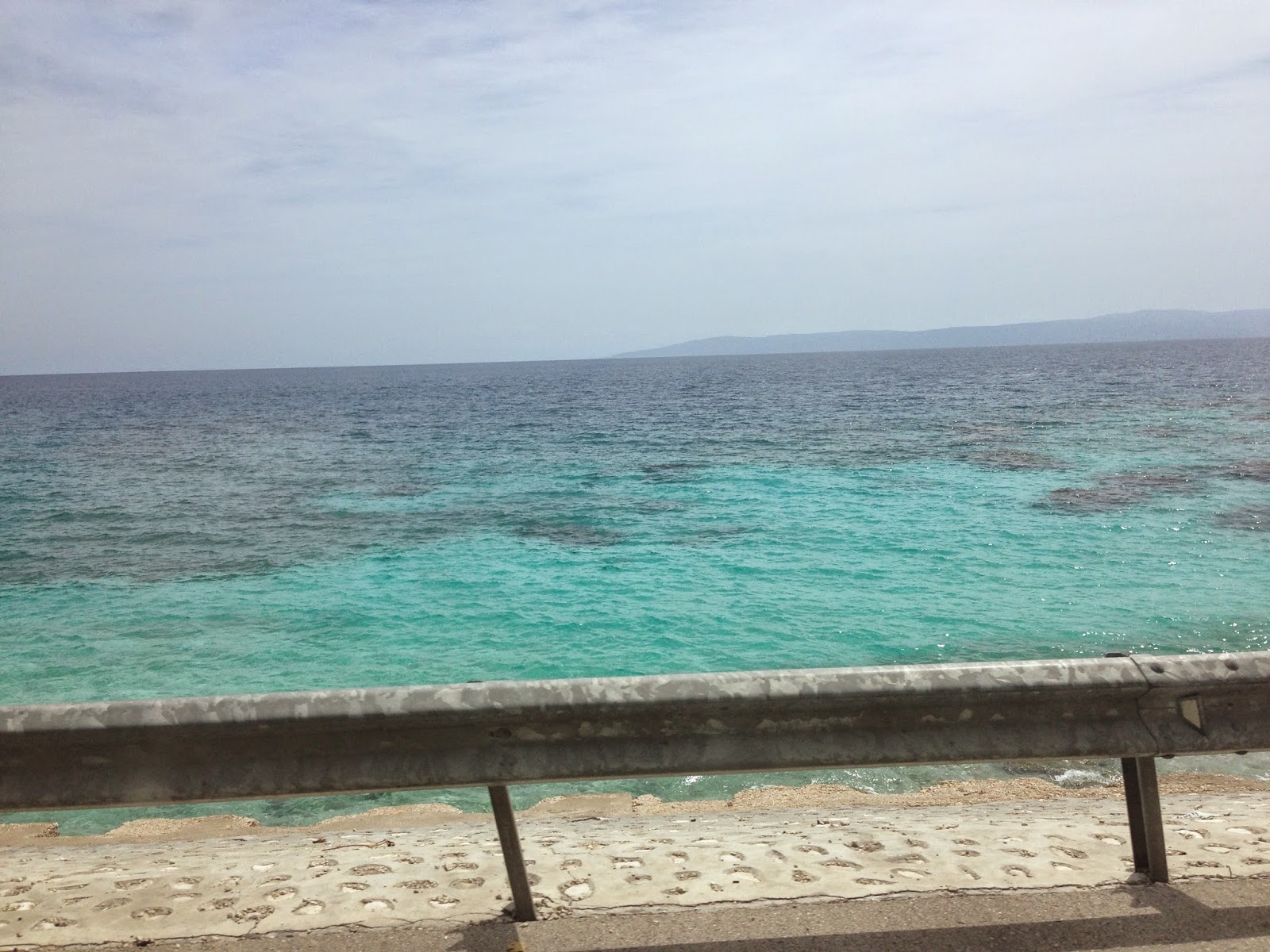
Once we deplaned, we got in line to get our passports stamped and to pay the entry fee.  Our Creole was immediately tested, but we managed enough to get through without any problems, found our bags and met up with Brittany, a former volunteer who visits as often as possible, Tiden, our driver, and Nate, an American volunteer for another organization.  We filled our truck with our bags and started the three hour drive north to Gros Morne.  The drive itself wasn’t too bad.  We were a little snug, but we started off with a snack of baked and salted plantain chips, had a lunch of fried pork, spicy piklies (onions and cabbage, I think) and some more plantains, and only the last 30 minutes were really bumpy.  We drove through several towns and along the coast, (our first close up view of the beautiful Caribbean water), passed the newly constructed Olympic stadium that will help athletes of all ages train, saw the “suburb” towns that sprouted up after the earthquake that have now become permanent settlements still with some blue tarp roofs, saw one of the mass burial sites for earthquake victims as well as a site where lots of people were murdered and buried under the Duvalier dictatorship.  We also got to see tons of mountains that would make for some awesome hiking.  There is one mountain not too far from where our house is in Gros Morne, that apparently is quite challenging, but all volunteers that go through the program have to climb it.  I can’t wait!!

We arrived at the house around 5, took a zillion trips to bring all our stuff up, sorted out the sleeping arrangements and had a little while to relax before dinner.  The house itself is beautiful and our dinner of goat and potato stew was very nice.  After dinner, we had our nightly prayer/reflection meeting and then we all hit the hay.  I won’t go into all the house details right now, so expect a post about everyday life a little later.


I didn’t take that many pictures while we were driving from PAP to Gros Morne because I just wanted to take it all in.  I’m sure we will be making the trip in the future, so I will take pictures then and post them later.  Enjoy!!!


My fellow Questers!


It's a little hard to see, but our first views of Haiti were of large and pretty intense looking mountains. That's what is in the middle of this photograph.


Flying in over Port-au-Prince.


This picture is a little confusing, but this is one of the towns we went through.  There were people, trucks and motorcycles everywhere.


I almost asked if we could stop for a dip...


My first true Haitian meal!


The view from my window!

Ann Pale Creole

The main reason we were in the Bronx was not to venture around the city, but to learn Creole, one of the main languages spoken in Haiti along with French.  I did a little research (OK, I read the Wikipedia page) and apparently the word “creole” in and of itself means a language that was created from the joining of two languages through what is called a “pidgin stage”, which essentially means a form of a language that has been simplified grammatically.

We can have a history lesson later on, but right now, all you need to know is that by the end of the 1600s, France had colonized the island and named it Saint-Domingue.  They imported thousands of slaves from Africa.  Initially they were unable to communicate with their masters, but over time, communication improved and the French spoken by the white men mixed with African dialects and eventually became an entirely new language.

Although it is impossible to know everything about a language in three weeks, over the course of the lessons, we did make a lot of progress.  It gave us a great base.  Learning any language is hard work, but I had a slight advantage because I speak French.  A lot of the vocabulary is similar sounding, so I was able to pick it up pretty quickly and I could understand a little bit better when just listening.  The grammar is totally different than French though.

We were being taught by Sr. Vivian.  She was one of the original sisters that went to Haiti to figure out if they should have a presence there, 17 years ago.  She has been there ever since, so she speaks Creole very well.  She was an excellent teacher.  She kept things interesting and included her own stories and cultural lessons within the language lessons.  Below, I’m going to give you just a brief introduction to the language.

Basic Vowel Sounds:
a — sounds like “ahhh”
e — sounds like “ay”
è — sounds like e in “get”
i — sounds like “eeee”
o — sounds like o in “boat”
ò — sounds like ending in “saw”

Diphthongs:
an — sounds like “aunt” if you say it with a British accent
on — sounds like “bon” if you say it in a French accent
ou — sounds like middle of “group”
en — sounds like en in “Kenya”
in — sounds like in beginning of “Minnie”


Pronouns:
mwen/m - I, me, my
ou - you, your
li - he, him, his, she, her, it, its
nou - we, us, our
yo - they, them, their

Greetings/Conversation starters:
Bonjou:  hello
Bonswa:  good afternoon/evening
Bònwit:  goodnight

Ki jan ou ye? - How are you?
Ki jan ou ye jodi a? - How are you today?
M pa pi mal - I’m OK (literal translation = I'm  no worse)
M ap kenbe - I’m OK (literally I’m holding on)
**Haitians do not often say that they are good (M byen) because they believe that they can’t be fine when so many of their fellow countrymen are hungry or suffering.

Ki jan ou rele? - What is your name?
M rele ____ - My name is…
Kisa sa ye? - What is that?
Ki kote sa ye? - Where is that?

Important Verbs:
manje:  to eat
genyen/gen:  to have
ye:  to be
mache:  to walk
kouri:  to run
chita:  to sit
swe:  to sweat
wè:  to see
pale:  to speak
ale:  to go
renmen:  to like


If I kept going, my entire blog would just be vocabulary.  I’ll write a few simple sentences and there’s a picture of a story I wrote that, if you feel so bold, you can try to translate.

 M bezwen kèk manje.  M renmen mango yo.  (I need some food.  I like mangos.)
M te wè yon petit chat nan mache.  Li te ye nwa e blan.  (I saw a small cat in the market.  It was black and white.)
M prale lekol la e m ap louvri pòt la pou klas la.  (I will go to the school and open the door to the classroom.)
M ap soti senkèkaranttwa apre midi.  (I will leave at 5:43pm.)

Even though we had such a good basis in Creole, it has been incredibly overwhelming.  I can pick up several words people say, but the people talk so fast, slur their words and cut a lot of them short, so it can be very difficult to follow.  Yesterday, however, we went to the school for an errand and ending up hanging out with some kids.  I sat with a 5 year-old and she taught me some words and we reviewed some  that I already knew.  It was nice to work with a youngster because they speak a little bit slower and use less complex sentences.  We start Creole lessons again this week with a Haitian teacher and I’m really looking forward to getting more and more comfortable speaking and listening.
We had to write stories in class one day.  Our assignment was to randomly choose 5 words from our flashcards and then put them in a story.  This is my rough draft, so there are a few grammatical mistakes, but for all intents and purposes, it is alright.  


Translation:  My New Dress
Today, Monday, it was market day.  I went to the market with my mother and my younger brother.  We needed to buy some socks for school.  On the road to the market, we saw many things.  My brother found 6 purple flowers.  They were beautiful.  Also, we saw Jack.  He was planting wheat.

At the market, I found the socks.  I got a gray pair and my brother got a green pair.  My mother bought some fruit.  We were almost finished, but I saw a beautiful dress.  It was yellow.  I asked if I could buy it.  She said yes!  I was very happy.  I wore the dress all day.  I was sad when I had to unzip it before I went to bed.

Sunday, August 31, 2014

The Start of Something New…

The program officially begin on August 7th.  But, I didn’t go directly to Haiti.  In order to be an effective volunteer and to successfully work in another country, it is absolutely necessary to be able to communicate with people.  For me, this meant being able to speak Creole.  So, on August 7th, I arrived in the Bronx to begin my three weeks of Creole lessons.  Now, the Bronx is not known for its Haitian population (surprising right?), but the sisters have a house there and we were going to be taking lessons at the house from a sister who had spent around 17 years in Haiti.  It also meant we could fly directly from JFK to Port-au-Prince, Haiti without any layovers - something that happens when flying from other airports.

In the Bronx, I met up with the two other Quest Volunteers.  Beth graduated from Catholic University in the spring and has been to Haiti twice before with the sisters for summer camp.  Frankie graduated from Towson in Maryland in the spring and has never left the country!  Starting on the 8th, we had class Monday through Friday twice a day for two hours.  Just when I thought I was done with school, I found myself back in a classroom!  Although this time, we sat at a card table in the chapel of the house and used giant pieces of paper for our “chalkboard.”  We learned a ton from our lessons, but I’ll give you all a mini Creole lessons in a later post.  The lessons were great and the knowledge we gained from the language acquisition and the stories told are essential for our success in the upcoming year.  But what was really fun about our time in the Bronx was that we were able to spend some time in the city and get to know each other before we were thrown into our adventure.  Instead of being thrown in as strangers, we could at least be thrown in as friends.

We spent three weekends in the Bronx and rearranged our schedule so we could have two Wednesday afternoons off as well.  We did a whole lot, but I’m going to just post a bunch pictures and briefly caption them.


This was my room in the house!


The first weekend, we took the subway downtown.  Our first stop was the 9/11 Memorial and then we took the subway up a little bit into Times Square. 

The memorial.

The Freedom Tower - it's still under construction.


Times Square was crazy!  There were so many people!


We walked around Times Square, and we ending up finding the American Girl Place.  Obviously, we went in.  We were the oldest people there (excluding parents) by at least 10 years.


The first Wednesday, we took the afternoon off and went to the zoo.  It was nice to get out for the afternoon and see something new.  It was a little bizarre to see exotic animals in the middle of a city.


I didn't take any photos during our lessons (no cell phones in class!), but here is one of us during break.

Frankie's in the blue and Beth is a little camera shy.


Homework


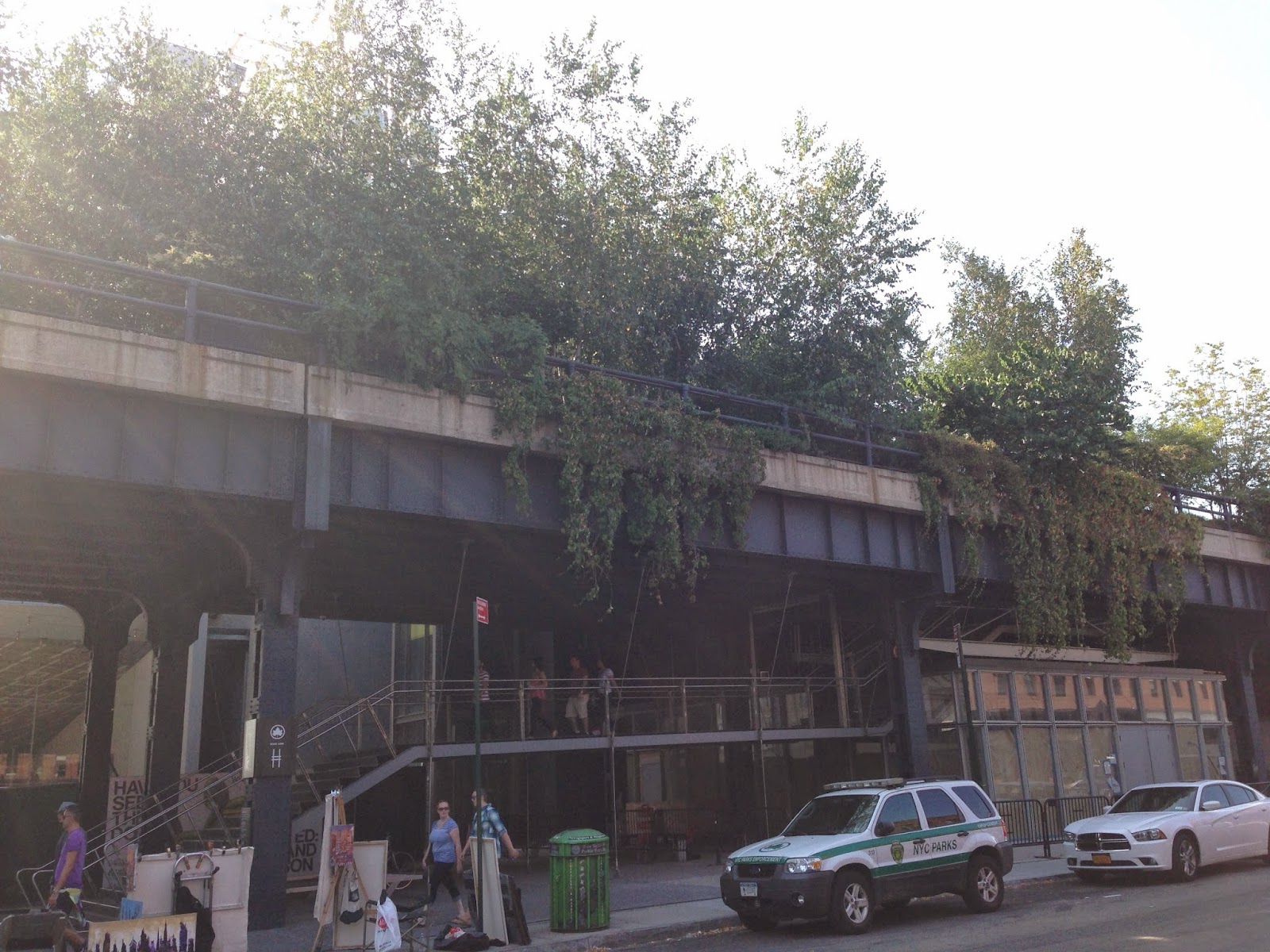
One of the summer camp volunteers this year has a grandfather that lives just around the block from the house.  She came and visited us a few times to talk about her experience and to show us around the city.  One afternoon, we took the subway downtown into southeastern Manhattan.  We walked through Chinatown, Little Italy, NYU and Soho.  We also walked along the Highline for a while.  This is an old elevated train that has been converted into a kind of nature walk.  It was so cool to be surrounded by trees, but still in the midst of a all the hustle and bustle.  I even got to take my shoes off and feel grass for first time since I had arrived in the city!


The final weekend, my parents were able to come visit on their way north after dropping my younger brother off at college.  Because I was in the city, I was hoping that I would be able to see a broadway show before I left.  My mom had somehow found some cheap tickets and we were able to see Cinderella!  The set was beautiful, the singing lovely and the costume changes were pure magic.  And, of course, I found my Prince Charming!


Times Square at 10:30 on a Friday = pure mayhem.


On Saturday, we walked around the city for a while and then headed back to the Bronx to meet up with one of my friends from high school who was coming from Boston for the night.

St. Patrick's Cathedral was under construction when we were there.  The scaffolding was almost as beautiful and awe-inspiring as the cathedral itself.

I also waited in line for cheap tickets for my friend and I to see A Gentleman's Guide to Love and Murder that evening.  The show won the Tony for best musical.  It was pretty funny and was very different than any of the other more classic broadway shows I've seen (like Wicked or Phantom of the Opera).

On Sunday, Sara and I went into the city again, found some bagels and did some serious people watching in Central Park.  After I dropped her off at the subway station so she could meet her family on Long Island, I made my way to the Natural History museum. 


This is actually a map.  The shells represent constellations and the oval in the lower right hand corner represents the boat.  Sailors would hold this chart above their heads to orient themselves and find their way home.


Central Park on my way back to the subway.